
Rating: Hold (WATCH). Teekay Tankers (NYSE: TNK) has done most of what I asked of it when the screen first passed it on June 11, and at roughly $94 I am holding it rather than adding. The reason is simple: the margin of safety has been cut nearly in half, from about 46% at the July reconfirmation to roughly 32% today, and the earnings holding it up are being lifted by a geopolitical rate spike that could reverse in a week. The balance sheet that earned the original PASS is stronger than ever. The price is what changed. The September 23 report moved TNK to WATCH, and I agree with the grade, though not entirely with the reason it gave.
The PASS rested on the balance sheet, not the earnings
The case in June was never that tanker earnings were durable. The screen's own qualitative note said the opposite: operating cash flow fell 35% in 2025, from $471.9 million to $305.9 million, as spot rates softened, and the company sold 14 vessels while paying large special dividends. Those are late-cycle signals, and the report called them that.
What carried the PASS was everything else. When the July 8 report reconfirmed it, TNK traded at 5.6x earnings and 1.10x book, with a current ratio of 7.98, no drawn debt, KPMG-audited financials with no red flags, and a Graham Number of $127.74, a 46% margin of safety. The material-event flag in that report covered routine fleet sales and purchases, nothing that changed the shape of the company. A cyclical business with almost no leverage and tangible assets close to the share price is exactly what Graham's enterprising-investor screen exists to find.
What changed: rates went to records, and the stock followed
Q2 was the best quarter in the company's history. Teekay reported GAAP net income of $225.9 million, or $6.49 per share, against $1.81 a year earlier (Q2 2026 6-K). Suezmax spot rates averaged $109,171 per day and Aframax/LR2 rates $74,149. With about 44% of Q3 days booked, Suezmaxes were fixed at $104,800 and Aframax/LR2s at $59,900: a strong third quarter, but already softer on the smaller ships.
The balance sheet got stronger, not weaker. Shareholders' equity reached $2,375.9 million, or $68.51 per share on 34.68 million shares, up from $59.15 in the 2025 annual report. Liquidity stood at $1.3 billion, including $735.0 million of cash and $476.6 million of short-term investments. Capital allocation stayed conservative: the fixed $0.25 quarterly dividend, no special dividend, no buyback, the sale of a 2013-built VLCC for $84.5 million, and two Suezmax newbuildings ordered for $190.0 million for 2027 delivery. That order is a little over 5% of market cap and funded from cash, nowhere near the material-event gate.
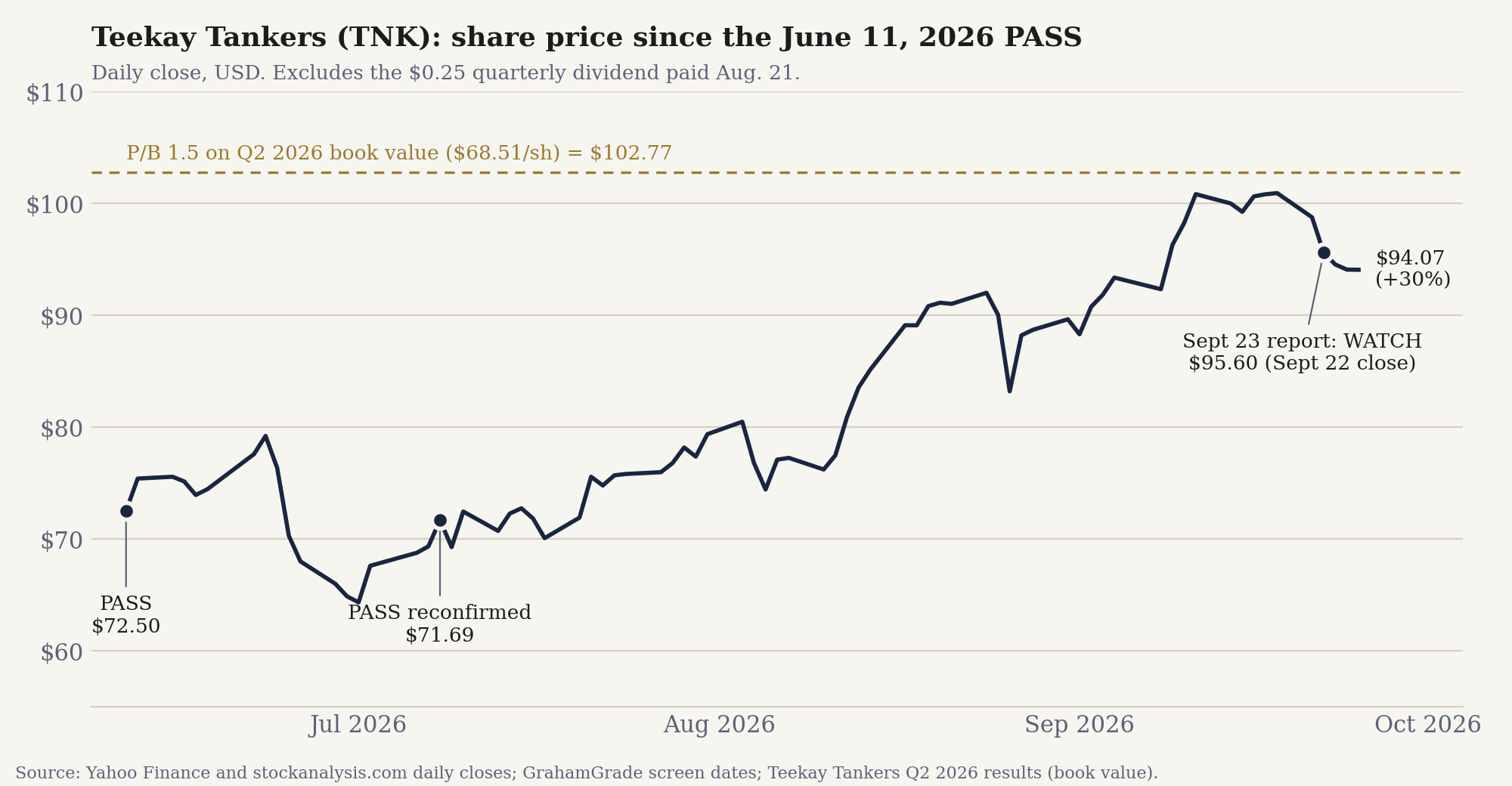
September turned a strong market into an extreme one. The Baltic Dirty Tanker Index more than doubled during the month, from 2,421 to 5,092, and VLCC charters topped $1 million per day on disruption around the Strait of Hormuz and a U.S. naval blockade of Iranian shipping (The Motley Fool). On September 22 the shares fell about 3% on reports that Iran had offered to reopen the Strait if the blockade were lifted. That one-day reaction is the clearest evidence of what is now in the price.
The stock went from $72.50 on June 11 to $94.07 at the September 25 close, a 30% gain including the $0.25 dividend.
On fresh numbers, TNK still clears every quantitative gate
Here the screen's own output needs a correction. The September 23 report showed P/B at 1.51, just over our 1.5 ceiling, but that ratio used the $59.15 book value from the 2025 10-K. On the Q2 book value of $68.51, the $94.07 close is 1.37x book (stockanalysis.com). Rerunning the core tests with current inputs:
| Test | Threshold | July 8 report | Today (fresh book, $94.07) |
|---|---|---|---|
| P/E (3-yr avg EPS $12.26) | ≤ 12 | 5.6 | 7.7 |
| P/B | ≤ 1.5 | 1.10 | 1.37 |
| P/E × P/B | ≤ 18 | ~6 | 10.5 |
| Current ratio | ≥ 1.5 | 7.98 | 9.99 |
| Graham Number | $127.74 | $137.47 | |
| Margin of safety | +46% | +32% |
The Graham Number is the square root of 22.5 × $12.26 three-year average EPS × $68.51 book value. The three-year average is deliberate: trailing EPS is $16.97, and building a valuation on September's rates would be exactly the mistake the average exists to prevent. So TNK is not a FAIL, and on the pure numbers it would still pass.
Why it's still a WATCH, and a Hold
The September 23 qualitative review graded TNK WATCH, citing a "deteriorating rate environment." That description is out of date. It was written from the same 2025 annual report that supported the June PASS, and rates today are at records, not deteriorating. I'm flagging it openly because a grade is only useful if the reasoning behind it is current.
I still agree with WATCH, for a different reason. The risk is no longer that rates are falling. It's that they are so far above normal that the market is now paying for them. At 5.7x trailing earnings TNK trades above its own five-year median of 4.5x (GuruFocus), and a cycle-peak multiple on cycle-peak earnings is not cheap. A 32% cushion is healthy for a stable business. For a spot-exposed tanker owner whose quarterly earnings can swing several-fold, I want more.
What would change the call:
- Back to PASS: a pullback to about $82.50, which restores a 40% margin of safety against the fresh $137.47 Graham Number, or rates holding near current levels through Q3 and Q4 results, which lifts the three-year EPS average.
- To FAIL: a close above $102.77, which puts P/B over 1.5 even on current book; a large debt-funded fleet purchase that trips the material-event gate; or a rate collapse that drags the three-year average down while the price holds.
Risks to this call
Rate cyclicality cuts both ways. Teekay's own September market update expects geopolitics to keep spot rates "well supported into Q4-26." If that holds, 2026 earnings will lift the three-year average and the Graham Number with it, and Hold may prove too cautious. If the Strait reopens and rates normalize quickly, the stock can give back a large share of its gains within weeks, as September 22 previewed.
Capital intensity. Fleet renewal is expensive. The $190 million Suezmax order is modest today, but a larger program at peak-cycle ship prices would convert cash into assets bought at the top.
Insider selling. GuruFocus reports $1.9 million of insider sales over twelve months and no insider buying. Small in context, but not a vote of confidence at these prices.
The limits of this check-in. This is an interim review, not a full new screen. A few months of price action say little about a business whose economics move over multi-year cycles, and the filing-based qualitative layer won't fully refresh until the 2026 annual report.
The discipline is in the re-check
TNK is a Hold. The balance sheet that justified the PASS has only improved, and on fresh inputs the stock still clears every quantitative gate. But the margin of safety has shrunk from 46% to about 32% as the market priced in record rates driven by a geopolitical disruption. I'm keeping my position and not adding above the low $80s.
The June PASS was right, but it was a snapshot, and the only way to keep a snapshot honest is to retake it. That is the case for running the screen every two weeks rather than once a quarter: a quarterly check would have missed most of this move in both directions. Over the next two cycles I'll be watching Q3 results, whether Suezmax rates hold above $100,000 per day, and whether the price approaches $102.77, where P/B crosses 1.5 on current book.
Want the full bi-weekly Graham screen, every PASS, WATCH, and FAIL with the numbers behind them? The GrahamGrade Screener is $8/month.
See a Sample ReportI have a beneficial long position in the shares of TNK either through stock ownership, options, or other derivatives. This article was drafted with AI assistance and reviewed by me, and it expresses my own opinions. I am not receiving compensation for it. I have no business relationship with any company whose stock is mentioned in this article. I am the founder of GrahamGrade, a value investing research tool used to produce this analysis. This article is for informational purposes only and does not constitute investment advice.
GrahamGrade is a subscription investment research publication. It is not a registered investment adviser and does not provide personalized investment advice. Reports are generated by applying a rules-based screening methodology to publicly available financial data, with qualitative analysis assisted by AI language models. Reports are provided for informational and educational purposes only and do not constitute an offer, solicitation, or recommendation to buy or sell any security. Information is obtained from sources believed to be reliable but is not guaranteed to be accurate or complete. Past screening results are not indicative of future investment performance. Investing involves risk. Consult a qualified financial and tax professional before making any investment decision.